By category
Also find these products by families


There are 95 products.










Showing 1-39 of 95 item(s)

In a garment decoration workshop, DTF - Direct To Film has reshaped daily production: no pretreatment, transfers that hold on almost any fabric, and batches prepared ahead of time. Printers, films, inks, powders and accessories make up this production chain. Manutech-Print selects them for textile customisation professionals.
Choosing a DTF printer determines a workshop's production capacity and the quality of its transfers for years to come.
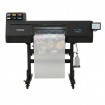
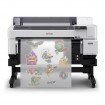
DTF printing systems come in two main configurations. Models equipped with 2 Epson printheads are perfectly suited to workshops starting in textile transfer or handling medium volumes. For intensive production, 4-head printers increase output by 40 to 50%, enabling printing speeds of up to 65 linear metres per hour.
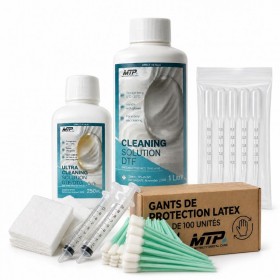
A high-performance DTF system requires regular servicing to maintain optimal print quality. Using specific cleaning solutions prevents printhead clogging and significantly extends their service life. Certain systems include CADlink Factory DTF RIP software, facilitating colour management and workflow automation.
Investing in a complete automated line - printer, powder shaker/curer, and heat press - pays for itself quickly through reduced operating costs and the elimination of textile pretreatment.
Understanding the differences between these two technologies helps you make the right choice for a textile customisation workshop.
Direct To Film significantly outperforms DTG printing in terms of throughput. The workshop prints its transfers in advance, then applies them in 15 seconds onto any textile with a simple heat press. This method eliminates the pretreatment constraints of DTG and offers unmatched reactivity for urgent orders.
Whilst DTG is essentially limited to cotton and requires specific adjustments according to fabrics, DTF adapts universally: cotton, polyester, synthetic blends, nylon, lycra. One transfer type for an entire textile catalogue.
DTF ink consumption represents 40 to 50% of DTG for an equivalent printed surface area. Transfer films and hot-melt powders remain affordable, generating a superior profit margin per print. Additional advantage: an existing DTG printer (Brother GTX Pro, Epson F2200) converts into a DTF production system using the same textile ink.
DTF transfers offer wash resistance comparable to screen printing, with durability exceeding 50 cycles at 40°C. The hand feel remains soft and pleasant, without any plastic effect, even on solid colour prints.
Choosing the right DTF film directly impacts the durability and finish of textile prints.
The market offers two types of DTF films. Hot Peel films are removed immediately after pressing, guaranteeing a smooth, clean finish. This technique particularly suits batch productions requiring rapid turnover. Cold Peel films, removed after cooling, also offer good quality but slow production flow.
Our range exclusively features Hot Peel to optimise productivity without compromising final quality.
Transfer sheets: A3 format or 40 x 50 cm (compatible with Brother GTX platens)
Professional rolls: 30, 40, 60, and 80 cm widths (100-metre length)
Format selection depends on the equipment and production volume. Rolls generate less waste and reduce costs on large batches.
Superior quality inks guarantee vibrant colours and prevent technical issues with the printheads.
High-density DTF inks ensure optimal coverage and remarkable colour saturation. Their specific water-based formulation prevents printhead clogging whilst guaranteeing excellent adhesion to PET film. Compatibility with Epson printheads DX5, i3200-A1, and 4720 enables easy integration on most market equipment.
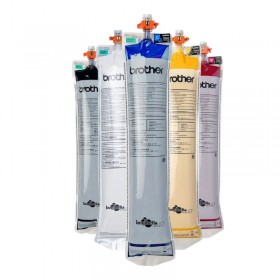
Cyan, Magenta, Yellow, and Black comprise the standard CMYK base. White ink constitutes the essential DTF element: it serves as an opaque undercoat enabling printing on dark textiles with brilliant colours. The quality of this white ink largely determines the final brightness of the transfers.
DTF powder ensures the bond between the print and the textile, an element crucial for transfer durability.
Medium White DTF powder, universal, suits 90% of standard textile applications. Its optimised granulometry ensures homogeneous fusion and lasting adhesion. Black powder specifically prevents dye migration on polyester textiles, a common problem with certain coloured synthetic fabrics.
Unfused surplus powder can be recovered and fully reused, considerably reducing consumable costs.
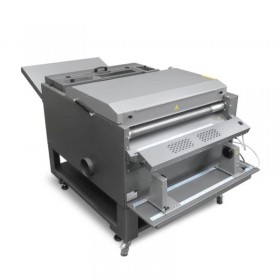
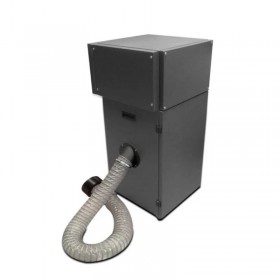
Automatic powder shakers integrate a recovery system and infrared curing oven. Vertical models occupy minimal floor space, which suits workshops with limited areas. Independent adjustments enable precise temperature regulation according to ink thickness and film type used.
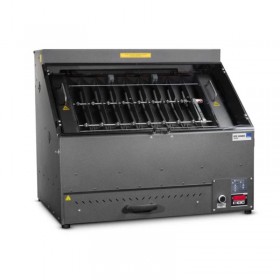
For production on A3 or A2 sheets, compact DTF ovens ensure uniform curing of hot-melt powder, guaranteeing maximum adhesion and optimal wash resistance.
DTF accessories and regular servicing extend equipment service life and optimise results.
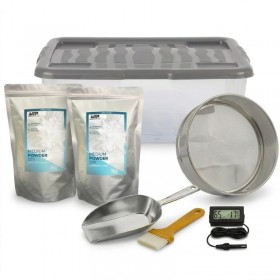
The DTF starter kit comprises indispensable tools: powder recovery sieves, transfer spatulas, Teflon protective sheets for heat press. These accessories guarantee optimal working conditions from the launch of the activity.
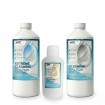
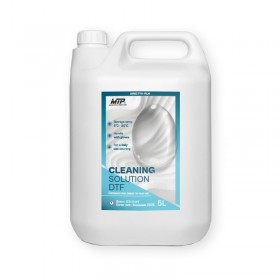
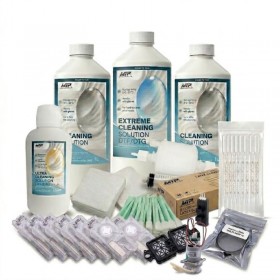
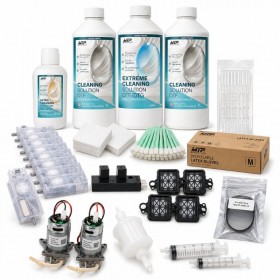
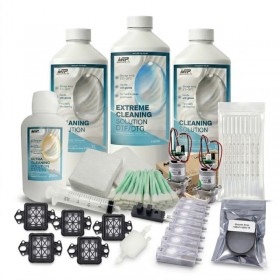
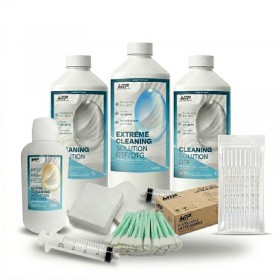
Specific DTF cleaning solutions dissolve ink residues without damaging electronic components. Replacement i3200-A1 printheads and ink circuits remain available to keep the production line running.
Mastering the complete process guarantees the quality of every textile transfer produced.
Automated systems sequence printing, powder application, surplus recovery, and curing without manual intervention. The film roll passes successively through the printer, powder shaker/agitator, then curing oven. This complete automation enables achieving industrial throughputs whilst maintaining consistent quality.
Each printer has its own inks, wear parts and maintenance references: Brother DTF, Epson DTF, Roland DTF and Mimaki DTF.
The advantages of Direct To Film transform the business models of textile customisation workshops. No pretreatment required, reduced production steps, controlled consumable costs, and unlimited textile versatility make DTF the essential technology for developing a garment decoration business.
For several years, our expertise has enabled us to select the best equipment and supplies on the market. We support every professional in choosing their adapted DTF solution according to their production volume and growth objectives.
Read more
expand_more
Also find these products by families
Showing 1-39 of 95 item(s)